
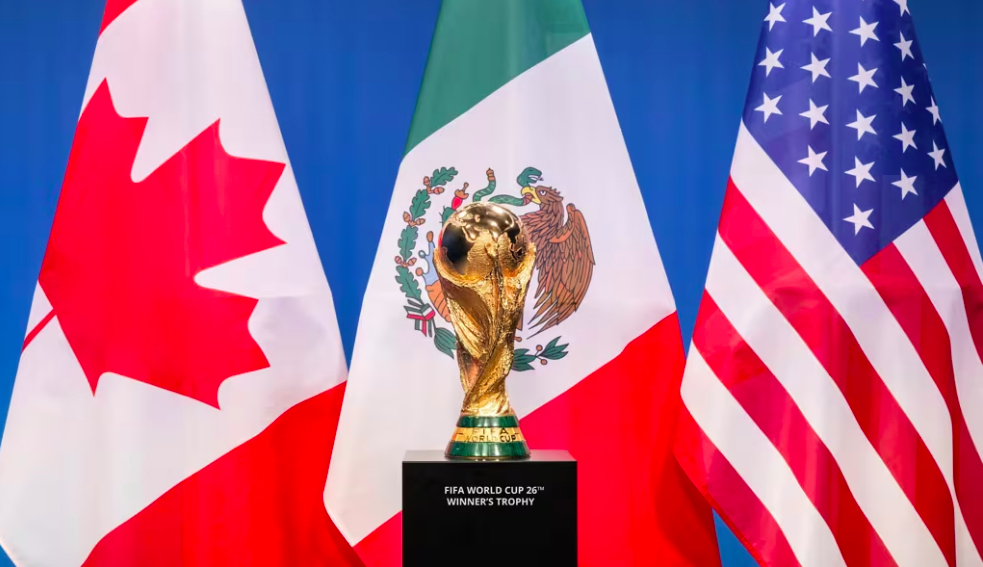
For the 2026 FIFA World Cup, slated to be co-hosted by the United States, Canada, and Mexico from June 11 to July 19, FIFA (football’s world governing body) has sold territorial broadcast packages widely. In the U.S., the 2026 tournament is already locked in with FOX in English and Telemundo in Spanish, as well as on Peacock streaming services. Streaming and broadcast coverage in Canada will be provided by Bell Media, while TelevisaUnivision and TV Azteca have reached an agreement to broadcast the tournament in Mexico.
Fan participation at the stadiums is estimated by FIFA to reach more than six million in-person attendees, with aggregates expected to exceed previous editions. There are nonetheless questions being asked of how many foreign fans (of the 1.2 million expected) will be able to travel to the United States amid stories of visa denials and diplomatic tensions, as well as worries that the tournament might become politicized. There is a credible risk that some individuals, or even entire delegations from some countries of the 48 teams (expanded from 32 for the occasion) divided into 12 groups, with five first-timers competing in the tournament, may face entry obstacles to the United States (like Haiti and Iran). One of the first-timers is the nation of Curaçao, which has 156,000 inhabitants.
There is a promised fast-track visa entry system, which will be implemented to ease travel by fans, with the U.S. Department of State and FIFA working together to unveil a program branded FIFA PASS (or “FIFA Priority Appointment Scheduling System”) to give World Cup ticket-holders earlier access to U.S. visa interview appointments. In practice it is a scheduling fast lane: people who bought FIFA tickets (through FIFA) will be eligible to request prioritized interview slots at participating U.S. consulates rather than waiting in the normal, often long, queue for a standard appointment. However, outlets and analysts emphasize that the program only expedites appointment scheduling; and consular officers retain full authority to deny visas. Wired and The Guardian have reported that official statements affirm that FIFA PASS “does not guarantee admission” and normal security and eligibility guidelines set by the administration remain in place.
While the plan in the United States is to expand free-to-air exposure (with more matches on network TV than the previous World Cup in 2022), throughout broadcast deal negotiations, rights packages have prominently included streaming. FOX will be streaming every match on FOX One (the FOX Sports app) alongside the record number of matches planned to be broadcast on FOX networks (principally FS1, although many matches will air directly on FOX’s primary channels), and NBCUniversal plans to pair the Peacock streaming services with broadcasts on Telemundo. In Canada, Bell Media will carry matches across CTV/TSN linear channels plus TSN/CTV/RS streaming apps, with multi-platform programming scheduled combining studio segments and preview specials. In Mexico, TelevisaUnivision will pair broadcasts with content on their ViX and TUDN streaming outlets.
Broadcasters expect large, simultaneous linear broadcasts of marquee matches such as finals, or matches involving large nations, while more niche time zones will be watching on streaming services. Streaming service platforms such as fubo, YouTube TV, Sling, and Peacock, along with Comcast/Xfinity services, are all preparing packaged offers to provide combined linear and streaming coverage.
FIFA, the event organizers, expect record viewership in this 2026 tournament to be driven by the tournament’s expansion to 48 teams, and being hosted across North America’s largest and most lucrative markets. While individual viewership is expected to vary widely from match to match, cumulative viewers might be measurable in the billions, and the final itself might draw in over a billion viewers.
However, analysts, as well as human-rights organizations such as Amnesty International, have warned that U.S. government policies enacted since 2020 which have included targeted travel bans, stricter vetting, “integrity” fees, and expanded discretionary powers at passport control, could still lead to exclusion for particular groups of fans, especially nationals from sanctioned countries, people with marginal records, people with records of protesting, or people who identify as LGBTQ+ or other vulnerable groups.
Political questions have also emerged from domestic affairs. U.S. president Donald Trump has publicly signaled he might seek to relocate matches out of some U.S. host cities he describes as unsafe or poorly governed. However, it is unclear as to how much of this rhetoric is merely political posturing, especially as matches cannot be unilaterally moved as a web of contractual obligations have already been stipulated between FIFA, the U.S. Soccer Federation, and host cities and venues. Threatening to move games from certain cities does however allow the president to present a “law and order” argument, which appeals to his base, positioning himself as protecting the marquee event. Further, by way of the prospect of stripping World Cup events from some cities, the White House can garner rhetorical leverage against local governments, typically in cities run by Democrats, on policing, homelessness, or other policy points.
Trump, who played what in the U.S. and Canada is called football, soccer, in high school, has said, “This is football. We have to come up with another name for the NFL stuff.” He has also held high-profile meetings and public photo ops with FIFA leadership as the tournament approaches. It is undeniable that hosting a successful 2026 World Cup will be a major soft-power moment for the United States, and any association that allows the president to take credit for a smooth, successful tournament will be politically valuable. The last time the World Cup (which was created in 1930) went to the U.S. was in 1994.
(By Yuri Serafini)
Audio Version (a DV Works service)


Leave A Comment