
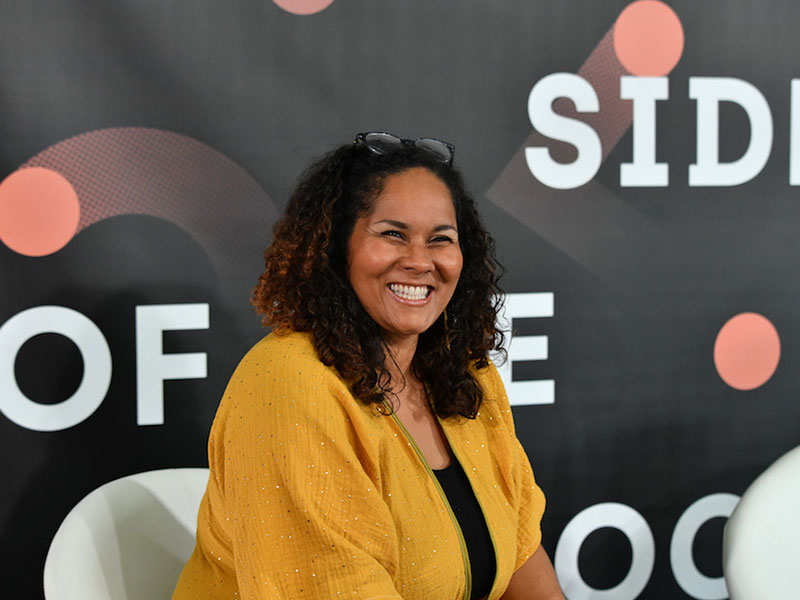
A videoconference interview with Aurélie Reman (pictured), managing director of Sunny Side of the Doc, produced some additional information on a topic difficult to evaluate at a global level — the documentary business and its various business models.
The videocall was coordinated by Philippe Le Gall, media coordinator for the 37th annual documentary market, which will take place June 22-24, 2026 in La Rochelle, on France’s Biscay Bay. This year’s event has been condensed to just three days (from the usual four), and has a reduced budget of 1.5 million euro (or U.S. $1.77 million), 32 percent of which was provided by public funding. That the event is taking place at all can be considered somewhat of a miracle since cancellation seemed imminent as of December 2025.
To explain a little about Sunny Side’s funding, Reman had this to say: “The 2025 budget was slightly above 1.65 million euro, so the drop year-on-year is just over 10 percent. The more telling comparison is against our historical baseline. In editions supported by Creative Europe MEDIA, the reduction is close to 20 percent. The absence of European funding is the main structural factor. We’re hopeful that support will return for 2027.”
Reman was, obviously, only able to speak to her own June documentary event, which consists of a festival, a market, and a conference, and is expected to draw some 2,000 participants from 60 countries. Eighty-two percent of that total will hail from Europe. Conferences at Sunny Side will revolve around international co-productions and international sales.
In addition, stated Reman, the documentary business is not stagnant, but always moving forward, especially with an increased number of wildlife productions, as well as an abundance of new TV outlets (like FAST channels) that are constantly being introduced.
When asked about other documentary topics, she said that “political documentaries are too risky to produce” because TV outlets are reluctant to air thems, even though the are best at denouncing extremism. As far as how documentaries are financed, “the public sector is still essential,” she explained.
According to Indiana University, there are approximately 68 documentary festivals around the world, and the global market for television documentaries was reportedly valued at $12.6 billion in 2024 and is projected to reach $15.8 billion by 2030.
With 15 documentary festivals, the U.S. leads the pack of the 36 nations that host such events, followed by Canada with nine such festivals, then England, France, and Spain with three each. Australia, the Czech Republic, Germany, Mexico, and Poland have two doc fests each. The remaining 26 countries, that span from Chile to Indonesia to Nigeria to Morocco to Latvia, have one such fest each.
Most of the doc fests are held in the month of March, followed by April with 13 events, and May and October with 10 each. The least favored months are January, August, and September, with one each.
Reiner Moritz, founding president of the Munich and London-based Poorhouse International, and a leading expert on music documentaries, seems to concur with Reman. “There is an insatiable appetite for the natural history genre,” he said, “although every animal or landscape on the planet has been filmed time and again. Social items and portraits of pop stars are en vogue.”
He said that he would define most political content “as reportage,” going on to explain that “legendary British filmmaker John Grierson defined documentary a ‘creative treatment of actuality.’ But now documentary might best be defined as an agreement between actual people to be creative.”
In addition, Moritz said that “prices range from seven digits to hundreds of dollars per hour according to subject matter. If one takes the last figures of MIPDOC there must be about a thousand buyers worldwide. Most documentaries go to public service media, but streamers are also interested in topics of general interest, when well made and/or attractively fronted.”
He then concluded: “The idea of sponsorship usually collides with truth, as a motive for underwriting is usually self-serving.”
According to Pasadena, California-based Ettore Botta, president of SpaceWoW, “acquisition license fees depend on the region. There are big differences between North America, South America, and Europe, also in terms of style and thematics. Unfortunately, the documentary acquisition in the U.S. is very complicated. In the last few years there have been several attempts by all kinds of producers, studios, and streamers to launch documentary channels in the U.S., [but they] fell apart [or were] suffocated by sensationalist TV and especially reality TV programs. In Canada, the CBC announced that they would close down their doc channel but increase their documentary production budget. We would need to
see what their program strategy is a bit further down the line. In the U.S., Amazon, Roku, Tubi, and Future Today, pay ‘peanuts’ rev-share for docs,” he concluded.
Similarly pessimistic is a European producer and distributor who asked to remain anonymous: “I stopped looking for new documentaries from other producers and instead focus on our own doc productions because what buyers want is hard to find, and because, out there, valid documentaries to distribute are too few. Adding to this is the economic crisis that touched the doc business, and you can see why it is more advantageous concentrating on our own productions.”
To Hervé Michel, a former French broadcast executive and past head of TV France International, “documentaries, even though the genre is very important, remain a niche genre. This is why in Europe, it’s mainly aired by public service TV and in late night slots, bringing less attention than mainstream programming like dramas or game shows.” Still, cautioned Michel, “one has to pay attention to its content (investigation and touchy subjects might be banned in some territories), its format (some markets only take series, some others only one-offs), and the budget dedicated to its production.”
However, a silver lining in the documentary business appeared following the recent announcement that the Los Angeles-based production and distribution company, Insurgence, teamed up with global documentary producer-distributor, New York City-based Big Media, to launch 60 YouTube documentary channels.
(By Dom Serafini)
Audio Version (a DV Works service)


Leave A Comment