
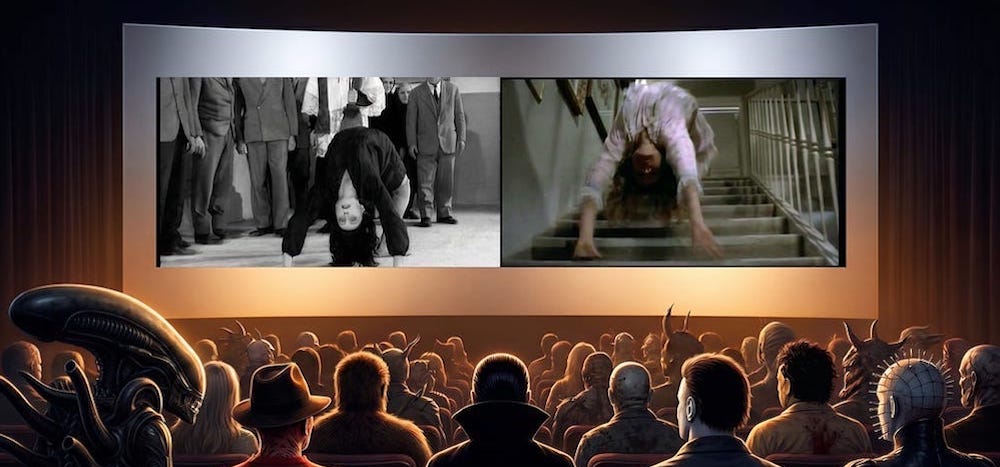
“Italian horror [cinema] of the 1960s and 1970s was, in the truest sense, an export industry,” wrote Giovanni Pedde, a former Rome, Italy-based VP of Sales for CBS Studios.
He continued: “What Italy was exporting was not imitation. It was origination: a complete set of tools for cinematic fear that the rest of the world adopted and claimed as its own.”
To prove his point, Pedde explained that “there’s a scene near the end of Il Demonio (The Demon) — Brunello Rondi’s 1963 film [in which] a peasant woman, believed to be possessed by the devil in a village in southern Italy, bends herself backward and begins to walk on all fours with her belly facing the ceiling. You know this shot,” wrote Pedde, “You’ve seen it in The Exorcist.” (Pictured above)
The late William Friedkin, The Exorcist‘s director, cut Regan MacNeil (Linda Blair) crab-walking down the stairs from the 1973 theatrical release because the wire-work wasn’t convincing enough. He restored it, digitally removing the wires, for the 2000 re-release, and it became one of the most discussed scenes in horror history.
The late Italian filmmaker Mario Bava’s Planet of the Vampires (Terrore nello Spazio, 1965) follows a crew that responds to a distress signal from a remote planet. “Watch it before you watch Alien (1979),” advises Pedde. “Alien screenwriter Dan O’Bannon later acknowledged taking the giant skeleton idea directly from Bava — he simply couldn’t find a better way to introduce the concept.”
“Bava’s Bay of Blood (Reazione a Catena, 1971) went further,” explained Pedde. “Two of its kill sequences were reconstructed almost shot-for-shot in the first Friday the 13th films, without credit.”
“The strategies that followed were sophisticated,” affirmed Pedde, “American movie directors adopted Anglo-Saxon pseudonyms [so the Italian] Bava became “John M. Old,” [movie director Antonio] Margheriti became ‘Anthony M. Dawson,’ [Ovidio] Assonitis became ‘Oliver Hellman’ — to make the films appear American. International casts were assembled for their exportable look. Since the Italian industry post-synched all dialogue anyway, a multinational cast cost nothing extra.
You could shoot with an American lead, an Italian crew and a German co-producer, dub the whole thing in London and nobody in Los Angeles could tell the difference,” Pedde said. “The result was a body of work so consistently in demand internationally that it routinely attracted foreign pre-sales — making Italian horror structurally independent from the domestic financing apparatus that would later strangle Italian cinema.”


Leave A Comment