
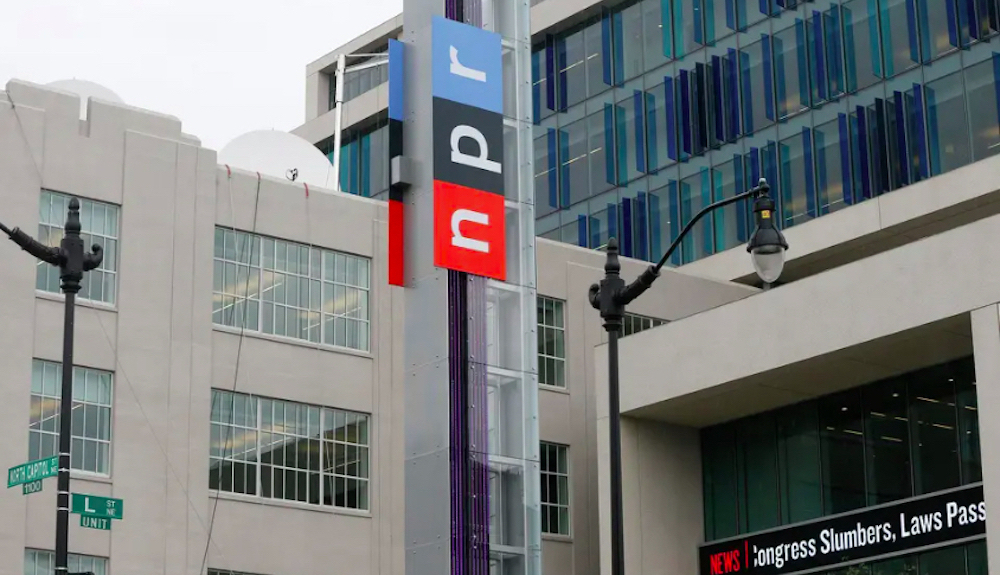
In the U.S., public media has become a public mess, with multiple organizations looking for private contributions, especially after the Trump administration took away the $500 million-a-year federal contribution from the now dismantled umbrella organization, Corporation for Public Broadcasting (CPB), which distributed the funds to public radio and public television. There are 15,393 radio stations in the U.S., divided by commercial, non-commercial, and non-profit (public stations and community stations), which number 3,989.
In the realm of U.S. public radio, the content providers are:
NPR: National Public Radio, created in 1970 and based in Washington D.C., with a West Coast office in Culver City, California. It syndicates its content to 1,000 public radio stations. It operates with a budget of $250 million a year.
APM: American Public Media, created in 2004 and based in Saint Paul, Minnesota. Distributes its programs to some 1,000 public radio stations. It operates with an annual budget of $117 million.
PRI: Public Radio International, created in 1983 as American Public Radio and based in Minneapolis, Minnesota. In 1994, it became PRI, and today it provides programming to 850 public radio stations and collaborates with the British BBC. Up until 2004 it distributed content for APM. It has an annual budget of $16.13 million.
PRX: Public Radio Exchange, created in 2003 in Cambridge, Massachusetts for digital content distribution to 445 radio stations. It has an annual budget of $20 million.
PMI: Public Media Infrastructure, created in 2025 by five public media organizations (APM, PRX, New York Public Radio, the National Federation of Community Broadcasters, and Station Resource Groups) with a $50 million grant from the CPB.
But since CPB, the private nonprofit organization created by the U.S. Congress in 1967, is closing down this month after it “completes the responsible distribution of all remaining funds” (as stated in its press release), the future of PMI is not too clear. According to a PMI news release, “Beginning in 2026, together with cohorts of partner stations, PMI will design and pilot new services, such as audience metrics.” However, according to a January 4, 2026 article in The New York Times, PMI “could eventually provide an alternative to a radio distribution system managed by NPR.” This evolved after September’s CPB dispute with NPR.


Leave A Comment