
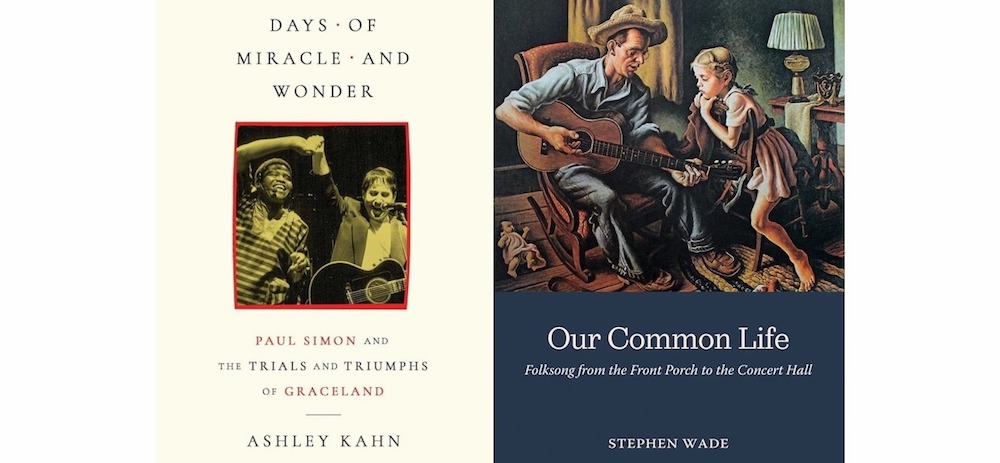
Two recent music book reviews — published two weeks apart in two major U.S. newspapers — offer revealing, contrasting perspectives shaped by their outlets’ leanings.
The first, a New York Times Book Review piece by Mark Braude, published August 15, 2026, considers Days of Miracle and Wonder: Paul Simon and the Trials and Triumphs of “Graceland,” by American music historian Ashley Kahn. The second, published in The Wall Street Journal’s Review section on September 5, discusses Our Common Life, by American folklorist Stephen Wade.
In its review, the Times highlighted how “Kahn considers broader political conflicts at play,” particularly Simon’s decision to break the boycott against apartheid South Africa. The Wall Street Journal review, by contrast, emphasizes the emotional power of folk music and its deep connection to ordinary American life. That brings to mind the paradoxical phrase quoted from Wade’s book: “how potent cheap music is.”
This idea of “cheap music” is especially interesting because it can mean many things. It can mean expensive classical music adapted into pedestrian tunes — such as The Beatles’ “Because,” which draws on the harmonic world of Beethoven’s Moonlight Sonata — or, conversely, a simple melody that acquires grandeur through elaborate arrangement and orchestration (like O Sole Mio).
Film reflects this same dynamic. A cheap or low-budget film can become a classic, while a lavish production can disappear almost immediately. A Fistful of Dollars and the original King Kong demonstrate the first possibility; The Adventures of Pluto Nash, with its enormous production cost and disastrous commercial performance, demonstrates the second.
There is also a linguistic contrast worth noticing between the two reviews. The Journal’s prose tends to be direct and readily accessible, whereas readers of the Times Book Review may encounter phrases such as “every scrap of paper gets its own exegesis” and “ungainliness and endless longueurs.”


Leave A Comment