
By Anna Beke-Martos*
Following the historic Hungarian election in April 2026, many in the TV industry hope that NATPE will one day return to Budapest. In the meantime, the Hungarian capital was home to another high-profile international event that took place September 7-8, 2026 — The A.I. Summit Budapest.
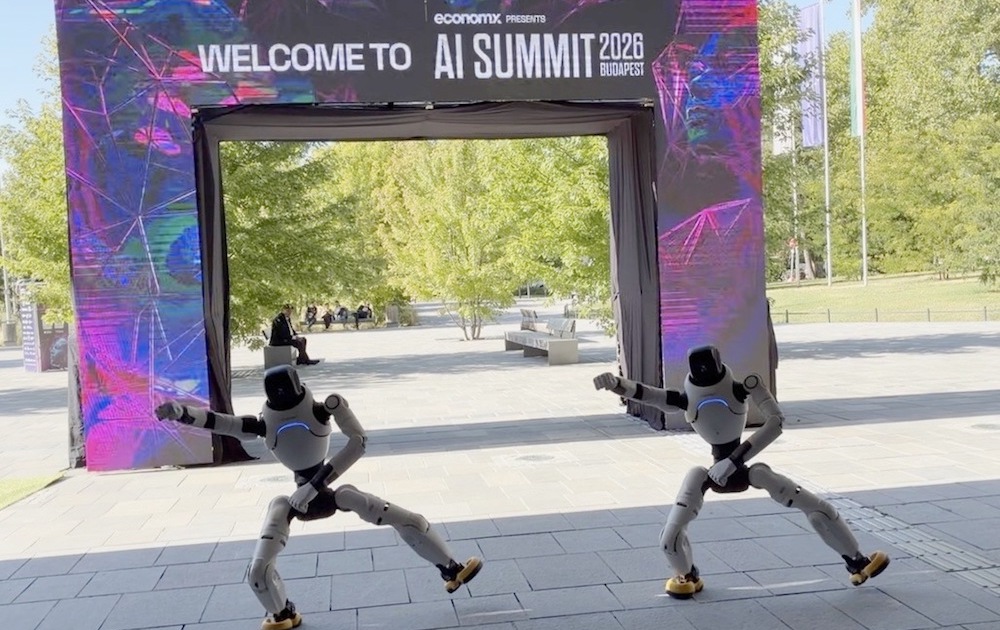
Dancing humanoid robots and tail-wagging robotic dogs greeted participants at the event, which took place across 13 locations within three buildings, in the heart of the city — including the architectural award-winning House of Music. With over 300 speakers over the course of two days, the Summit explored the light and dark sides of A.I. across a broad range of fields, including, finance, medicine, education, the arts, media, and entertainment.
The Summit offered some truly thought-provoking take-home messages, especially with regard to TV-content creation and editing. Who will be willing to spend money to travel around the world in order to film on location when all of the surroundings can be generated by A.I.?
The changes will affect talent too. Actors will need to be trained with an even stronger emphasis on being able to perform using only their imagination to create their surroundings. This is ironic considering that according to the medical studies presented at the Summit, it is exactly this human, child-like ability — the power to use one’s imagination — that is most severely damaged by the excessive consumption of screened content at a young age.
In a “Real or Not Real” session, content creators invited viewers to discern which images were created by A.I. and which were captured in real life. The quiz turned out to be a guessing game rather than an exercise in attention to detail. Many presenters hailed the E.U.’s A.I. Act, which became applicable on August 2, 2026, with the aim of mitigating risks related to A.I.
The fact that A.I. is not human is currently the primary reason why courts in Europe and the U.S. deny copyright protections to genAI-created works. The Committee of Copyright Experts (on whose expert opinion courts in Hungary regularly rely to decide copyright disputes), reasoned that the translation of an instruction manual should be copyright-protected because although the original text predetermined the content of the translation, the (human) translator still had a choice to make between the various possible expressions of that content in a different language.
The rationale behind denying copyright-protection to genAI-created works still stands: Machines have no legal personality, cannot be held legally responsible (and even if they could be, they do not own assets from which reparation could be sought), and, perhaps most importantly, do not need to earn license fees from the use of their “creations” to allow them to eat.
Nonetheless, some presenters at the Summit invited audiences to treat A.I. not just as a tool, but rather as a co-worker. With respect to screenwriting, it was acknowledged that while A.I. should not take over the task of writing text, it can be a useful tool to give feedback — almost like an editor or a friend in their first reading of the material.
In any case, the already often murky lines between intelligent contribution and copyrightable creation will likely become more and more blurred with the advancement and increasing use of genAI.
Many sectors of the creative industries warned that while A.I. may be used to cut costs, the price might be higher: A loss of color and variety. The one point on which there appeared to be an over-arching consensus among experts in every field affected by A.I. focused on the younger generations: Children should be taught to think with their own minds, learn to study, garner their own knowledge by memorizing, processing, and internalizing information, and master traditional research- and critical thinking skills before they are allowed to use A.I.
*The author is a Hungarian attorney. The opinions expressed in the above article are the author’s personal views and do not constitute legal advice.


Leave A Comment