
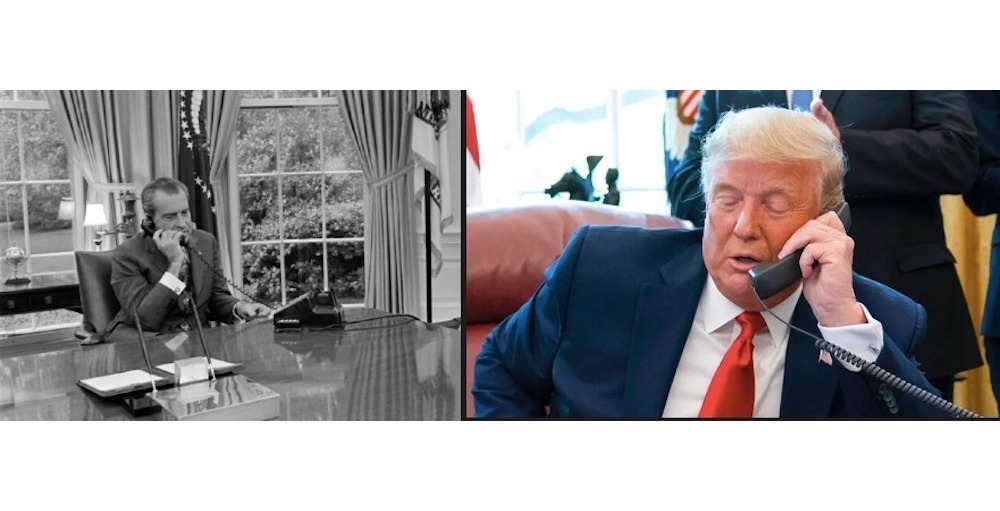
Republican U.S. President Donald Trump famously posted last year that American TV networks ABC and NBC “should pay up big for having the privilege of using the most valuable airwaves anywhere at anytime. Crooked journalism,” he wrote, “should not be rewarded, it should be terminated.”
It is not the first time that a U.S. president has wanted to eliminate what he considers unfavorable news. In 1973, Republican President Richard Nixon targeted the CBS, NBC, and ABC TV networks, accusing them of unfavorable reporting. And his vice president, Spiro Agnew, blasted critics of the administration, calling them “nattering nabobs of negativism.”
On September 5, 2026, former FCC chief economist Thomas W. Hazlett published an opinion piece in The Wall Street Journal examining why U.S. TV networks face unique constitutional limits. Hazlett — now an Economics professor at Clemson University — explained how broadcast media operates under different First Amendment standards than other press outlets, limiting their full constitutional protection.
“While most media operate in a laissez faire regime,” explained Hazlett, “terrestrial radio and television broadcasting are licensed, and their airwave access has sometimes been deemed a privilege, not a right.”
He then quoted Harvard Law constitutionalist Laurence Tribe, who traced the anomaly to a technical error, “a profound fallacy about spectrum scarcity,” and the late comedian George Carlin, who said that “radio and television [are] the only two parts of American life not protected by the Free Speech provisions of the First Amendment to the Constitution.”
Then, Hazlett put the blame for such “anomaly” squares on the U.S. broadcasters themselves. “The 1927 Radio Act’s ‘public interest’ language,” began the professor, “was written by the [broadcasters lobbying group], the National Association of Broadcasters. The broadcasters traded freedom for free licenses and a lucrative, protected market. Only a handful of viable stations were assigned to more than 80 TV channels. In return, regulators gained clout over an industry and influence over content,” explained Hazlett. “In 1978, when Rep. Lionel Van Deerlin (D., Calif.) proposed to rewrite the Communications Act — granting TV stations greater Free Speech rights in exchange for a modest fee on revenues — the National Association of Broadcasters opposed the bipartisan reform.”
Finally, he added: “When Senator John McCain (R., Ariz.) and Senate Majority Leader Bob Dole (R., Kan.) argued that the 1996 Telecommunications Act should sell TV stations their new digital broadcasting licenses at market prices — and liberate both their content and their spectrum — the industry again rallied to block deregulation.”


Leave A Comment