
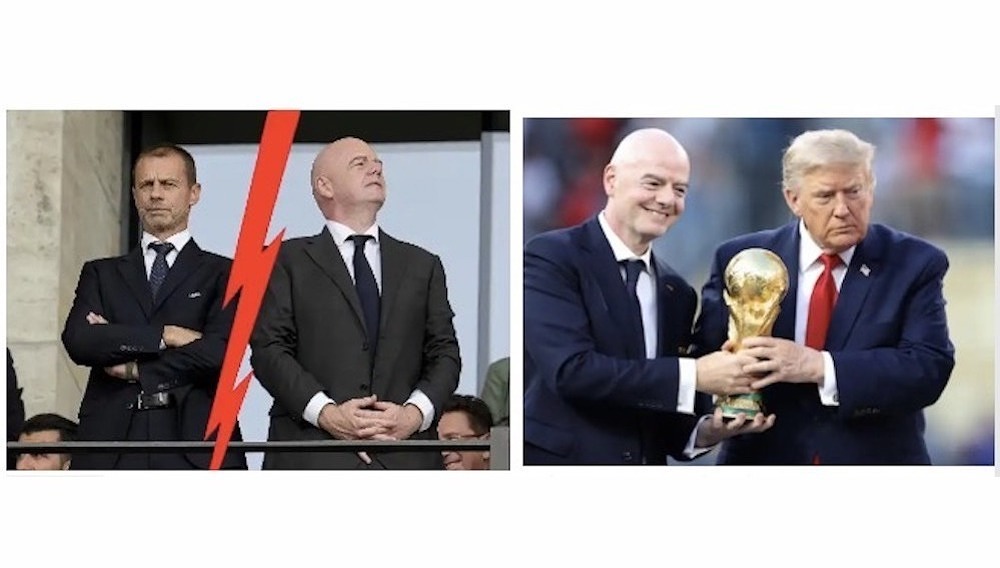
The FIFA-UEFA clash over FIFA’s planned privatization of TV and other rights made Gianni Infantino reverse course. Infantino, president of FIFA, the Swiss-based international football organization, had intended to establish a commercial entity valued at $20 billion, into which TV rights, sponsorship deals, and stadium ticket sales for both national teams and World Cups would have been consolidated. The venture, called “Forward Enterprise,” would have used JPMorgan as an investment banker, and included men’s, women’s, and youth football games.
The controversial plan, which entailed selling a 20 percent stake — worth $4.2 billion — to an investor group led by Thrive Capital, a fund belonging to Joshua Kushner (the younger brother of Jared Kushner, U.S. president Donald Trump’s son-in-law), was devised a year ago, but was leaked to the press on July 28, 2026.
The new commercial venture was awaiting approval by FIFA’s 211 members, when it was stopped in its tracks. Infantino had originally given the associations’ federations until September 19 to accept or reject the plan, which required approval from a majority of FIFA’s member associations. The proposal had immediately drawn criticism from football leadership across the globe (with the Americas’ football federation, CONCACAF also voicing opposition), and had met with a firm “no” from UEFA’s 55 European federations — including smaller ones that might otherwise have been tempted by the $40 million payout over the next four years that Infantino promised as early as 2027. “The World Cup cannot be treated as an investment product,” UEFA’s statement read, adding: “The soul and governance of football are not assets to trade, especially with zero transparency. None of us are the owners of football. It’s not FIFA’s to sell.”
Reportedly, if Infantino had not reversed course and scrapped the project he initiated, UEFA might have seriously worked on organizing an alternative World Cup, independent of FIFA’s control and featuring the top five European teams — France, Spain, England, Germany, and Italy (who all adopted a hardline stance against FIFA’s new initiative) — alongside wealthy federations like Argentina and Brazil, plus some from Asian and African nations that refused to accept FIFA’s compromise (which many described as tantamount to blackmail).
In a unanimous decision by its 55 members, UEFA had announced that it would boycott all FIFA tournaments, including the World Cup, stating: “No UEFA national team will participate in any FIFA competition as long as these proposals remain in effect, unless the proposal is abandoned in its entirety and binding guarantees are provided that FIFA will never again open its governance or competitions to private ownership,”
Being rich (the 2026 World Cup has generated $15 billion), the strategy Infantino would have used to persuade some federations to back his project was money — $40 million over four years to those who supported the new plan. Hence Infantino’s idea of an invitational “mini-World Cup” featuring the top teams — since smaller federations would have found it harder to say no to Infantino’s money. Under Infantino’s plan, it would not have been difficult to involve 24 teams, which was the number of participants in the 1994 World Cup.
The question, however, was if the current FIFA monopoly could have been challenged, since, once FIFA opened the door to private involvement in the commercial management of tournaments, it would have become much harder for FIFA to block an alternative project organized by others.
Originally, FIFA had announced its intention to continue its “open and democratic” consultation with stakeholders regarding FIFA’s plan to “privatize” the World Cup, and, according to the Wall Street Journal, “an opportunity to deepen the organization’s ties to the orbit of president Trump,” who requested and got a reversal of a red (expulsion) card issued to an American player during the World Cup. At the recently concluded World Cup, FIFA also included “hydration breaks” to add more TV commercial time, and gave a made-up peace prize to President Trump.
Infantino took over the FIFA presidency in 2016 in the wake of a massive FIFA corruption investigation. He’s now preparing to run (so far unopposed) for a third full term in office next year.
Pictured above, in a rendition by Italian Webnews, Dagospia, Infantino (right) with the president of UEFA, the Slovenian Aleksander Ceferin, who boycotted the World Cup finals over President Trump’s involvement with the red card reversal. Infantino with president Trump.


Leave A Comment