
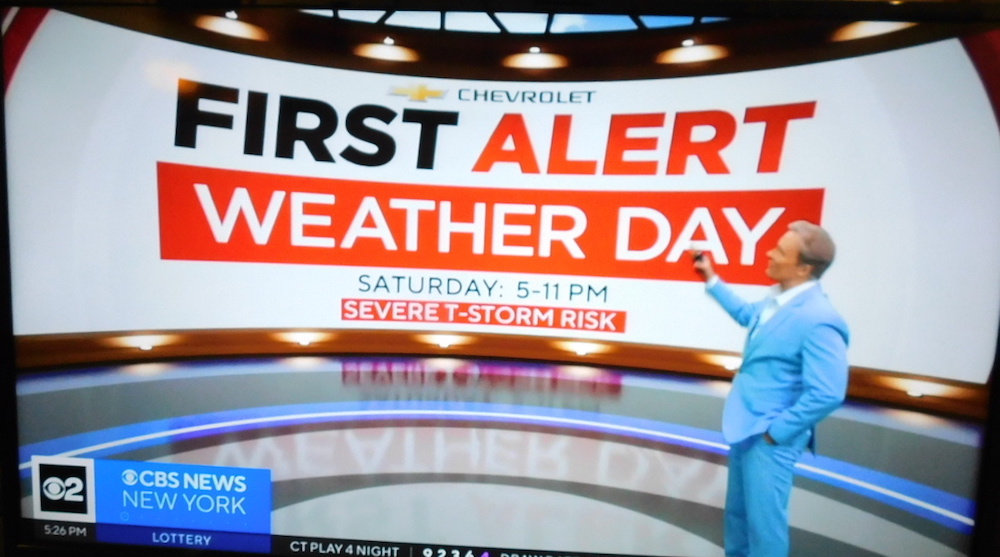
Do you remember the journalistic maxim, “Just the facts, ma’am?”
Why doesn’t it apply to America’s TV weather people? We can get used to their “partly cloudy or partly sunny” statements (with the former uttered for weekdays, and the latter for weekends). We can also tolerate the occasional unexpected rain shower. But why can’t weather people just stick to the simple facts, like tomorrow’s weather first, and later go babbling about how lucky we are to be their viewers?
Instead, they start the telecasts reciting current temperatures and local weather conditions (which we all know), then go to the satellite maps showing conditions in other regions (which we don’t care about). Then, they show us all possible scenarios for the coming weeks (which isn’t necessarily urgent). At this point, they break for commercials, assuring us that they’ll be still there after the interruptions. When they finally return, there is the usual chitchat with other newscasters, and then they, mercifully, go to the map that depicts the weather pattern for the following day. Naturally, the temperatures are given in Fahrenheit and the potential rainfall in inches.
Local and network outlets in the U.S., seemingly in order to lose the few people who still watch broadcast television, still cling to the 1724-era Fahrenheit scale (which is abbreviated with an “F” since it is a difficult word to spell out), and to the 1324-era inch unit of measurement, when even the U.K., along with the rest of the world, changed to the metric system years ago (or at least they show numbers in centimeters and centigrade together with inches and Fahrenheit).


Leave A Comment