
By Dom Serafini
Since July 4, 1776, there have been only a few 50-year milestone anniversaries of American independence: 1826, 1876, 1926, 1976, and soon, 2026.
I was personally involved with the 1976 celebration of America’s 200th birthday when I videotaped a bicentennial parade on Long Island, New York (said tape was donated to the Moriches Public Library), and I am organizing the upcoming 2026 event in Giulianova, in the Abruzzo region of Italy, sponsored by the Italian-American industrialist Mario Daniele.
Once the Second Continental Congress (the First Congress took place in 1774) adopted the Declaration of Independence from the British (and in particular from King George III) on July 4, 1776, church bells began to ring and cannons were fired throughout the original 13 American colonies.
On September 9, 1776, the same Continental Congress declared the name of the new nation to be the United States of America. Army General George Washington became the first president of the USA in 1789.
“America” is named after the Italian Amerigo Vespucci (who called his explored land, the “New World”), making America, and the USA in particular, very close to Italian hearts.
However, each 50-year celebration in the U.S. has been marred by controversy. Issues facing the festivities have included the displacement of Native Americans, the divisive matter of race, the Civil War, women’s suffrage, Prohibition, Civil Rights, the women’s rights movement, the Vietnam War, and now President Donald Trump. In addition, this year, a deluge of “America250”-themed merchandise was put on sale in the U.S. and overseas by an obscure (and unresponsive) U.S. commission. A May 19, 2026 article in USA Today said that the company was “cashing in on history.”
Indeed, each celebration over the years has taken stock of America’s achievements and failures. In his book, The Flag Was Still There, author Todd Bennett wrote, “Each 50 years since 1776 has found our country at a crossroad.” And Eddie S. Glaude Jr., a professor at Princeton, wrote in his recent book, America U.S.A., “American anniversaries are often moments to turn a blind eye to evils of the past and present.”
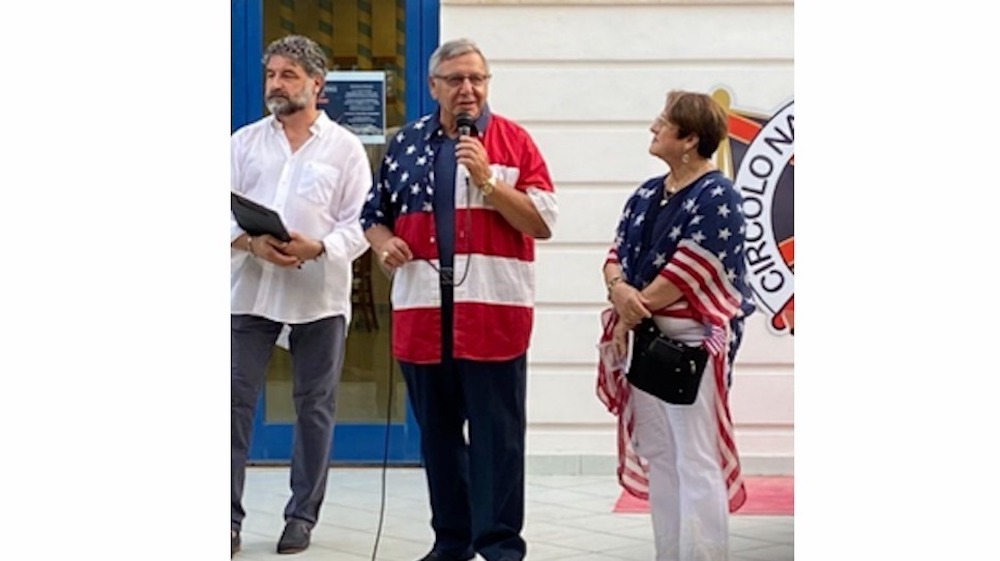
The only relatively “quiet” Fourth of July celebrations were those in between commemorations, like the one I organized in Giulianova last year, the first ever Independence Day in Abruzzo, which was attended by 25 Italian-Americans (and 75 Italians). But even then, the ritual gave an opportunity to Americans to both congratulate themselves and to argue about the country’s political and social directions.
Regardless of what happens at the celebrations, the American Revolution, which at times was called an “experiment” by commentators, is not over, even though the abolitionist Samuel May, in 1856, declared the “1776 experiment” a failure. The Revolution did not end in 1776. It continues in 2026 and beyond. This year, on its 250th anniversary, the occasion for controversy is renewed, bringing back both a celebration and a challenge. But the American experiment lives on not only in America, but on this Fourth of July, also in Giulianova.
Mario and Flora Daniele of Rochester, NY (pictured) at last year’s 4th of July celebration in Giulianova.


ciao Dom linter Vento e andato bene grazie al signore , ora devo recuperarare. ilmio ritorno in italia sara ‘Agosto ora mi auguro che la festa del 4 luglio sara’ di gradimento di tanti .
io auguro a tutti un pomerigio pieno di gioia e soddisfazione .un abbraccioforte