
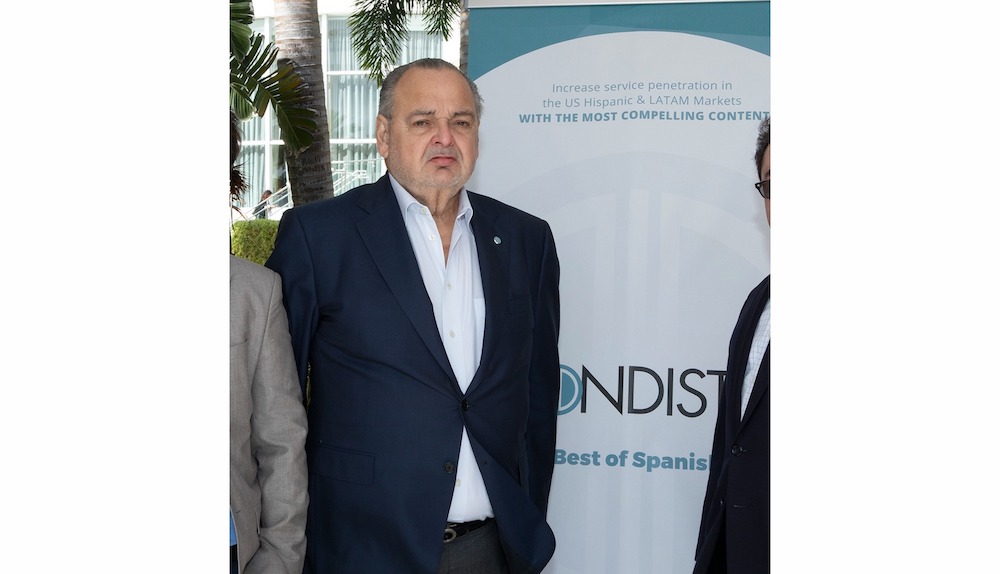
“I’d like to first speak a little about the politics,” began an email sent by Jorge Fiterre (pictured above), the Cuba-born founder of the Miami, Florida-based Condista, a satellite international TV program distributor. He then continued: “The biggest misinformation out there [about Cuba] is the so-called ’embargo.’ The fact is that Cuba can buy food, medicines, and other items from the U.S. The only requirement is that they must pay up front [because] Cuba has a long history of not paying its bills. When American companies don’t get paid, they make their claims to their government, and it’s the U.S. taxpayers who end up footing the bill. Other countries have had to adopt similar cash-up-front policies.
“Regarding our TV industry, the Cuban regime controls all media. If citizens are caught listening to radio or watching television content that isn’t the regime’s, they will lose their jobs and end up in jail.
“Cuba has played a big role in the development of the radio and television industry [in Latin America]. As a Cuban who is involved in the industry, I take a lot of pride in many of Cuba’s past achievements. Perhaps one of the most notable was the novela.
“The Cuban cigar industry had skilled workers rolling cigars. To keep these workers entertained, they usually read newspaper articles to them. The workers were paid at the end of each workday. The problem was that if workers met their financial needs, they would not show up for work the next day. So, the factory owners came up with an idea. Instead of newspapers, they would read long novels that took longer than one day. This way, the workers would be interested in coming to work the next day. That’s why some Cuban cigars have names like Romeo y Julieta and Montecristo (from the Count of Monte Cristo).
“In 1945, Cuban artist Felix Caignet wrote an original script for a popular radio novela. It was named El Derecho de Nacer. Then, in 1951 Cuban radio/TV pioneer Gaspar Pumarejo aired the first telenovela on Union Radio y Televisión Channel 10 in Havana. It was a radio and TV simulcast.”
Afterwards, Fiterre went back to talking about politics by explaining the role of GAESA, the conglomerate of state-owned Cuban companies, but he made sure to point out that he’s “not talking as a person that was with the prior regime. My father had to seek asylum and was forced into exile during Batista’s dictatorship. As a mater of fact, my father was a political prisoner. One of his cell block prison inmates was Fidel Castro himself.”
According to Fiterre “GAESA is an extension of the Castro regime and an impediment” to democracy in Cuba. “This conglomerate of companies is the property of the Fuerzas Amadas Revolucionaria, the military,” said Fiterre, who added: “The Castro regime expropriated all private businesses. Big and small. It did the same thing with all other ownerships, such as private homes. The only solution that can help the future and economy [in Cuba] is free men and women through free enterprise.”


Leave A Comment