
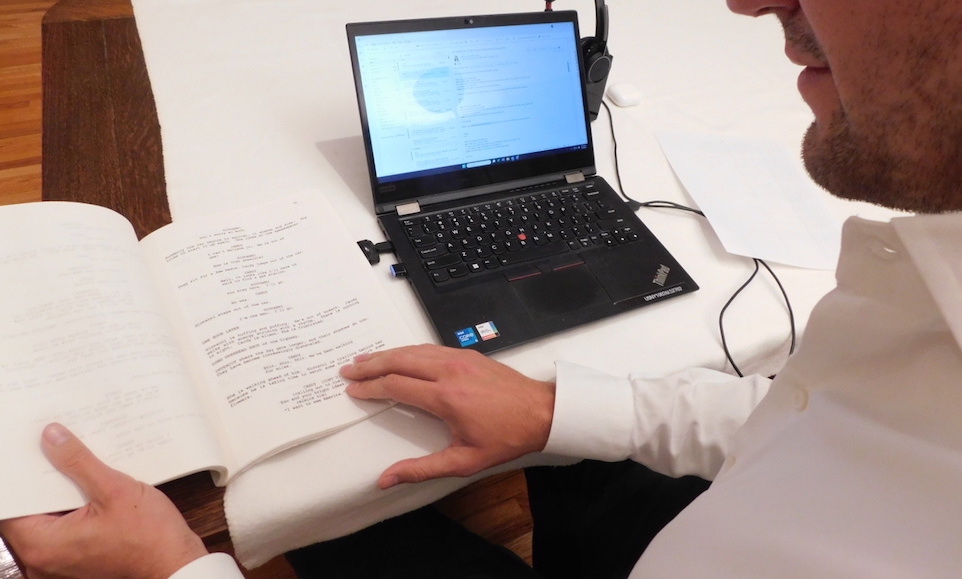
If you feel sorry for those who translate Shakespearean works into different languages (including standard American English), imagine how hard it is to translate TV scripts from, let’s say, Turkish or Japanese, into neutral Spanish (which for Spanish-speaking LatAm is either Mexican or Colombian).
Not only does the translated script need to mean the same thing as the original, but the words also have to try to match the opening of a given performer’s mouth. Also, when translating, let’s say from English to other languages, the number of words usually increases, which is obviously a problem.
But it’s important work. As British professional translator Daniel Hahn pointed out in his recent book If This Be Magic, print translations can be a “bridge between cultures.” International content sales executives are in agreement, pointing out that TV translations also help to reduce cultural gaps, so that local viewers can identify with the series’ characters.
In order to better understand the business of TV translation, VideoAge‘s Water Cooler reached out to three dubbing houses — one in Miami, Florida; one in Barcelona, Spain; and one in Mexico City, Mexico.
Like book publishers, dubbing houses keep hundreds of translators in their contact lists, but according to Carlos Sánchez, CEO of Mexico City’s Caaliope, “If you’re not using Artificial Intelligence and you’re simultaneously dubbing around 60 hours of different projects, you’ll need at least 10 translators. If you are using AI in the same example, you might only need two translators responsible for quality control.”
Based in Barcelona, Jacques Barreau, VP of TransPerfect (which also has offices in Los Angeles and New York City), reported that all of his firm’s translators are freelance and that all work for several companies at the same time.
Miami-based Gema Lopez, CEO of Universal Cinergia, said: “We have 100 translators in different languages, including English, Spanish, French, Portuguese, Hebrew, Castillian, Arabic, etc.”
When asked about rates, Lopez stated that costs for translation into LatAm Spanish, for example, reach up to 45 Mexican pesos per minute, which is around U.S. $120 per 45-minute episode. For Sánchez, the cost is U.S. $2 per minute with a script and $2.50 without, while Barreau just said that “the price of translation is included in the dubbing cost.”
This arrangement, valid for all dubbing houses, states that rates are based on time (minutes) and not the length or number of lines to be translated. Each 45-minute episode can have from 300 to 700 lines, and on the average takes three days to translate.
As far as whether it’s harder to translate a drama or a comedy, Barreau considers comedies more difficult since the “jokes have to be adapted to the local culture.” Sánchez concurred, noting that the translator must be familiar with local slang [both the original and translation] in order to make a comedy work. He added that “there are specializations within translation. Some specialize in comedy, others in scientific documentaries, or historical topics, as well as dramas and horror.”
In addition, according to Sánchez, it is the dubbing director at the dubbing house who determines if words are too long (or too short). At Barreau’s TransPerfect an “adaptor” is charged with changing the translation to fill an actor’s lips. Often, the translator and adaptor are the same person.
Finally, when asked about the commissioning entity, Sánchez said that “clients” are generally studios, tech houses (so-called laboratories), streaming platforms, or legacy TV channels.


Leave A Comment