
Before direct sound became a fixture in film and television shows, most non-U.S. TV programs were dubbed, even in the same language. Dubbing has always been an important element of any program, to the point that the U.S. studios would do their own dubbing before selling their programs overseas. The expansion of dubbing has now created such a competitive international marketplace that some dubbing houses are willing to dub one TV episode for free, with the understanding that, if the series is sold, the producer (or distributor) will use the same house for the whole series. Right now, for example, many LatAm countries would not acquire a foreign TV show if it hasn’t already been dubbed.
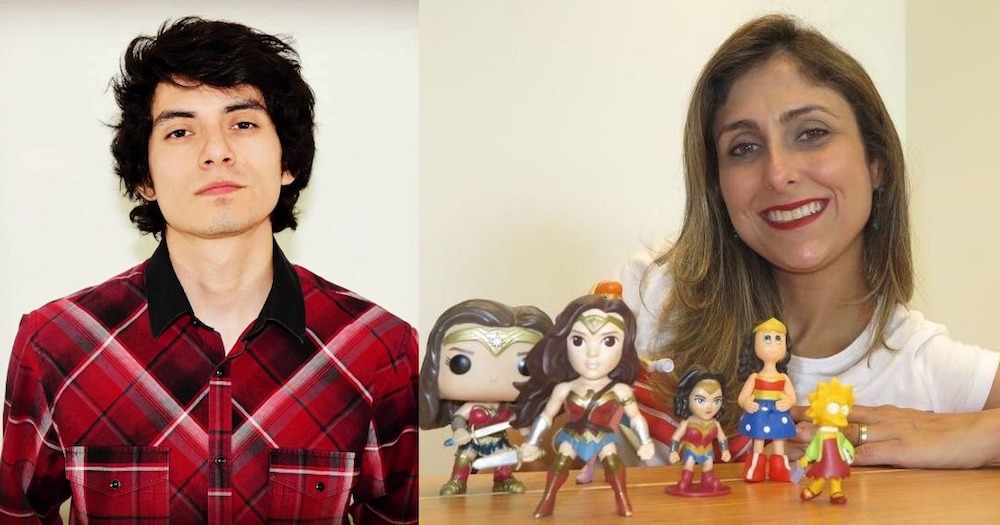
For this reason, VideoAge‘s Water Cooler reached out to the executives at the Miami, Florida-based Universal Cinergia in order to interview two of their voice talents — Ivan Garcia and Flavia Saddy (pictured above from l. to r.) — in order to better understand their points of view.
VideoAge: Do you dub for the same actor? And for how many actors?
Ivan Garcia: I have a few recurring characters in both live-action series and animated projects. There must be at least eight of them. If we were talking strictly about live-action actors, three.
Flavia Saddy: Yes, around 40 regular actresses, such as Gal Gadot, Margot Robbie, Natalie Portman, and Kristen Stewart, among others.
VideoAge: What type of content do you enjoy dubbing the most — drama, animation, action, or another genre — and why?
Ivan Garcia: I enjoy drama because it allows me to explore human emotions that are much more grounded in reality. I enjoy animation because it gives me the freedom to really lean into exaggerated and larger-than-life emotions. Since the work often involves a heightened, farcical style, it makes the job all the more fun.
Flavia Saddy: I prefer drama because it requires more detailed artistic work.
VideoAge: Have you ever turned down a role or refused to dub for a particular actor? If so, what factors influenced your decision?
Ivan Garcia: Unless it involves a workplace where payment or scheduling is unreliable — or working with difficult people — I aim to work with as many different companies and colleagues as possible, and to learn from them.
Flavia Saddy: Yes. Projects that may involve a lot of exposure, as I am a more private person. [And] I have already declined dubbing for erotic films.
VideoAge: Which original language do you enjoy dubbing from the most?
Ivan Garcia: I enjoy dubbing from any language. I learn from how my fellow actors approach their respective techniques and how cultural nuances shift from one language to another. However, I’d say I’m particularly accustomed to — and really enjoy — working with Japanese material. I get a real kick out of just how intense it can be.
Flavia Saddy: I prefer productions spoken in Spanish, as I am more familiar with the language.
VideoAge: Which is harder, laughing or crying?
Ivan Garcia: Crying is the harder of the two — but only because I experience it so intensely. Even if it lasts just a few moments, those tears always come straight from the soul.
Flavia Saddy: Crying is usually more difficult because it requires both emotion and technical control at the same time. But laughing, depending on the type, requires diaphragm training and proper breathing techniques.
VideoAge: Which kind of scene makes you laugh, even if it’s meant to be serious?
Ivan Garcia: I love comedy that stems from improvisation — those moments where you can tell the people involved are taking everything dead seriously, and it looks like no one is willing to be the first to crack, so they just keep pushing the situation further and further.
Flavia Saddy: Scenes of exaggerated panic, and some horror films.
VideoAge: Which kinds of scene typically requires the most takes?
Ivan Garcia: When it comes to serious scenes, I sometimes struggle to find my rhythm if I don’t fully grasp the character’s objective. That often leads to retakes and having to do additional takes — it really just comes down to maintaining focus.
Flavia Saddy: Scenes involving crying, screaming, or physical effort usually require more takes, as well as scenes with many people speaking at the same time.
VideoAge: Is your voice protected by copyright? Do you receive royalties?
Ivan Garcia: Yes — I am protected under Mexican law. However, I do not yet receive royalties for my voiceover work.
Flavia Saddy: Yes, the use of the voice is protected by copyright, and we receive additional compensation depending on the type of contract signed with the companies.


Leave A Comment